Eye test symbols can look confusing the first time you receive your prescription, especially when the chart is full of short codes like SPH, CYL, Axis, PD, ADD and Prism Many people hand the paper to the optical store without really knowing what these numbers mean, but understanding eye test symbols helps you ask better questions, notice changes in your eyesight and choose lenses that feel more comfortable in daily use
What do eye test symbols mean in a prescription?
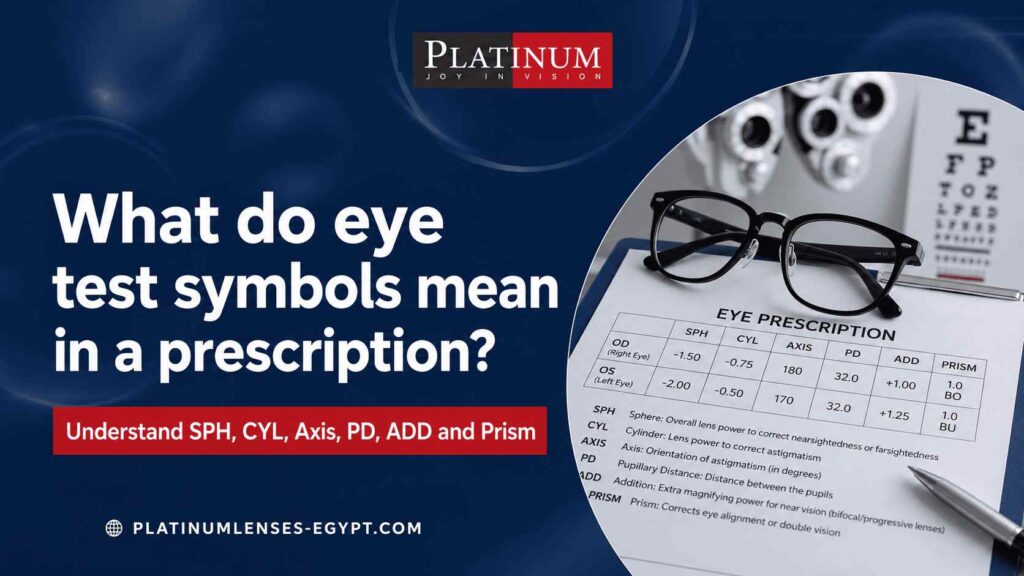
Eye test symbols are short codes used to describe your visual needs in a clear and organized way Each symbol explains a different part of your prescription, from the main lens power to astigmatism, near vision support and lens centering inside the frame
The important thing is not to memorize every medical term, but to know what each symbol affects in real life SPH can explain whether you struggle with distance or near vision, CYL and Axis are linked to astigmatism, PD affects how the lens sits in front of your eyes, ADD helps with reading and Prism is used in special alignment cases
Why should you understand eye test symbols?
Understanding eye test symbols makes it easier to choose glasses with confidence, especially if you compare lens options, buy online or notice that your vision has changed since your last exam Your prescription is not just a group of numbers, it is a guide that helps the optician make the lens match your eyes as closely as possible
Better lens accuracy
When you understand eye test symbols like SPH, CYL, Axis and PD, you can see why lens manufacturing needs accuracy A small mistake in one value may not sound serious on paper, but it can affect comfort, clarity and how natural the glasses feel on your face
Easier online buying
If you order glasses online, eye test symbols become more important because you are entering the values yourself A wrong PD value or a missed Axis number can make the glasses feel uncomfortable even if the frame looks perfect
Better follow up over time
Comparing eye test symbols over time helps you notice changes in your eyesight If your numbers change quickly, especially in children or people with certain health conditions, it is better to book a proper eye exam instead of only changing the glasses
What does SPH mean in eye test symbols?
SPH stands for Sphere and it describes the main lens power needed to correct nearsightedness or farsightedness It is usually one of the first eye test symbols people notice on a prescription because it often has a plus or minus sign next to it
Learn More
What Does SPH Mean in an Eye Test?
Negative SPH and myopia
A negative SPH value usually means myopia or nearsightedness This means close objects may look clear while distant objects can look blurry If someone has SPH minus two point fifty, they may struggle with road signs, classroom boards or distant details without glasses
Positive SPH and hyperopia
A positive SPH value usually means hyperopia or farsightedness This means nearby tasks like reading, phone use or long periods of close work may feel harder Some people with farsightedness notice eye strain before they notice obvious blur
SPH strength and lens thickness
The higher the SPH number, the stronger the lens power needed This can affect lens thickness, especially with larger frames or higher prescriptions If the number is high, the optician may recommend a thinner lens material for better comfort and appearance
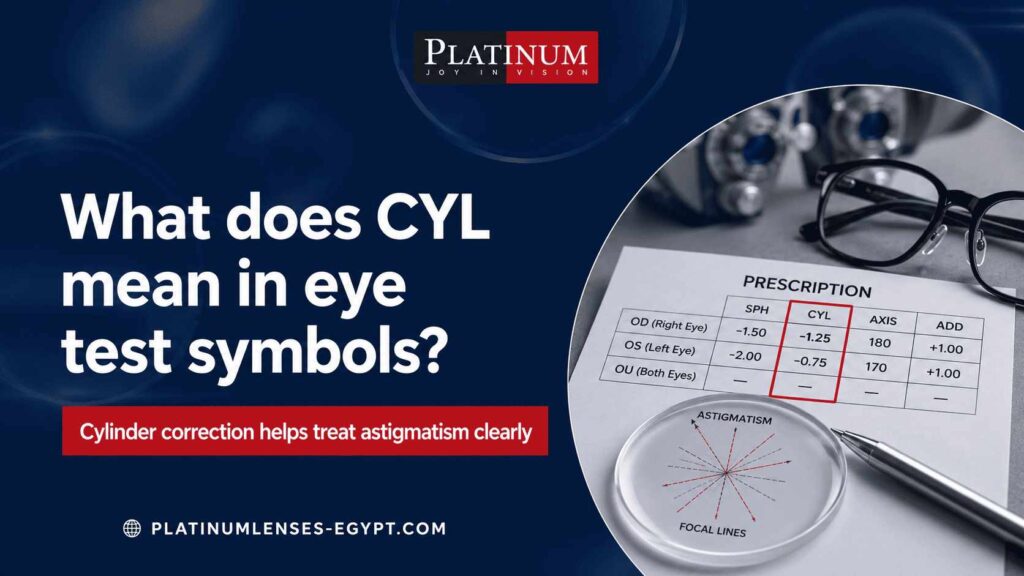
What does CYL mean in eye test symbols?
CYL stands for Cylinder and it is used when the prescription includes astigmatism Astigmatism happens when the curve of the cornea or lens is not perfectly even, so light does not focus in one clean point
If the CYL box has a value, the lens needs cylindrical correction If the box is empty, says Plano or has zero, there may be little or no astigmatism correction needed CYL is one of the eye test symbols that should always be read with Axis because both values work together
Positive and negative CYL values
CYL can be written with a plus or minus sign depending on the prescription format used by the doctor or optician The sign itself is not something you need to worry about alone, because the final lens is made according to the full prescription, not one field only
CYL and blurred vision
A higher CYL value can make vision look shadowed, stretched or unclear, especially at night or under strong lights This is why people with astigmatism often feel that the picture is not sharp even when they are not extremely nearsighted or farsighted
What does Axis mean in eye test symbols?
Axis works with CYL and tells the optical lab the direction of astigmatism correction It is written as a number from 0 to 180 degrees and it helps place the cylindrical power in the right direction inside the lens
Axis is not a power value It does not mean the prescription is stronger or weaker by itself It simply tells the lens where the correction should sit, and this makes Axis one of the eye test symbols that can strongly affect comfort
Axis and lens comfort
If the Axis value is wrong, the lens may feel strange even if the CYL power is correct This can cause blur, eye strain or a feeling that the glasses are not stable, especially with stronger astigmatism
Axis with CYL
Axis usually appears only when there is a CYL value because it completes the astigmatism correction If CYL explains how much correction is needed, Axis explains where that correction should be placed
What does PD mean in a prescription?
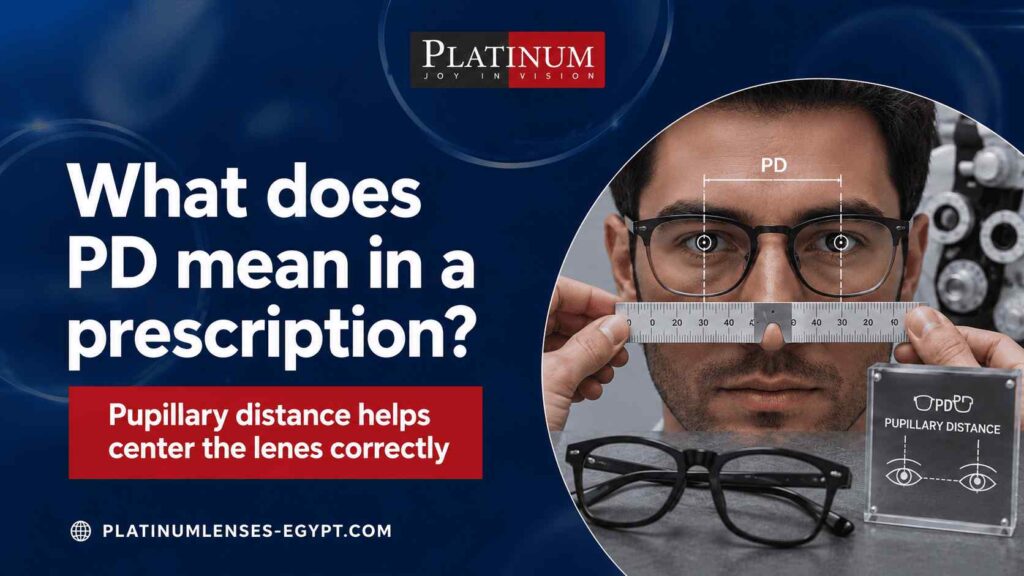
PD stands for Pupillary Distance and it measures the distance between the centers of your pupils This number helps the optical lab position the lens centers correctly inside your frame
PD may look like a small detail, but it can make a big difference in comfort If the lens center does not match your pupils, your eyes may work harder to see clearly This is why PD should be treated as one of the most practical eye test symbols when making glasses
PD for lens centering
A correct PD helps the strongest and clearest part of the lens sit in front of your eyes This is especially important with stronger prescriptions, progressive lenses and online glasses orders
Wrong PD symptoms
A wrong PD can lead to headaches, eye strain, blurred vision or a feeling that you need to adjust the frame to see properly This is why PD should be measured carefully, not guessed
What does Cylinder mean in a prescription?
Cylinder is another way to refer to CYL It describes the astigmatism correction needed in the lens, so it is linked to the shape of the cornea or the way light focuses inside the eye
Some prescriptions write CYL while others may use Cylinder more clearly Both refer to the same idea, which is correcting uneven focusing caused by astigmatism
Cylinder and astigmatism
Cylinder value tells the lab how much astigmatism correction is needed, while Axis tells the lab the direction of that correction These two values work together and should be read as a pair
Cylinder in lens design
A prescription with Cylinder often needs more care during lens manufacturing because the lens must be positioned accurately inside the frame This is why accurate fitting matters, not only the written prescription
What does ADD mean in eye test symbols?
ADD stands for Addition and it is extra power added to help with near vision It is usually used for people who need support for reading, phone use or close work, especially after the age of forty
ADD is often used in progressive lenses, bifocal lenses or office lenses It is normally written as a positive value such as plus one point zero, plus one point fifty or plus two point zero ADD is one of the eye test symbols that usually appears when near vision needs support
ADD for reading
If you start holding your phone farther away to read, or if small text feels tiring, ADD may be part of your prescription This does not always mean your distance prescription is wrong, it may mean your eyes need extra help for close tasks
ADD with progressive lenses
Progressive lenses use ADD to create a smooth shift from distance vision to intermediate and near vision This is why accurate measurements and good lens design matter when choosing this type of lens
What does Prism mean in eye test symbols?
Prism is not found in every prescription It is used when the eyes need help working together, especially in some cases of double vision or eye alignment problems
Prism changes how light enters the eye so both eyes can work more comfortably on the same target This part of the prescription should always be handled carefully by an eye care specialist
Prism direction
Prism may include a base direction such as in, out, up or down This direction tells the lab how the prism should guide the light inside the lens
When Prism is needed
Prism may be used for people who experience double vision or certain alignment issues It is not a normal addition for every glasses wearer, so it should not be added unless the specialist includes it in the prescription
Quick guide to eye test symbols
This table gives you a simple overview of the most common eye test symbols before choosing your lenses
| Symbol | Meaning | What it affects |
|---|---|---|
| SPH | Sphere power | Nearsightedness or farsightedness |
| CYL | Cylinder power | Astigmatism correction |
| Axis | Astigmatism direction | Direction of cylindrical correction |
| PD | Pupillary distance | Lens centering inside the frame |
| ADD | Extra near power | Reading and close work support |
| Prism | Image alignment correction | Double vision or eye alignment cases |
| Base | Prism direction | Direction of the prism effect |
This table is useful as a quick reference, but the full prescription should still be reviewed by an optician before making the lenses
Which Platinum lens can match your prescription?
After you understand your prescription symbols, the next step is choosing a lens that fits your actual needs Platinum Lenses offers different solutions depending on whether you need simple correction, astigmatism support, screen comfort or near vision help
| Your prescription need | Suitable Platinum option | Why it may help |
|---|---|---|
| Mild or moderate SPH correction | HD UT | Thin and light daily visual comfort |
| High astigmatism | X Perience T | Digital Ray Path 2 support for clearer peripheral vision |
| Long screen use | Office Lens with MIRA Blu | Intermediate vision support with blue light protection |
| Near vision after forty | X Tend progressive lens | Smoother transition between distances |
| Increasing myopia in children | Myo D | Designed to help manage myopia progression |
The right choice depends on the full prescription, not one symbol only A lens should be chosen after checking SPH, CYL, Axis, PD, ADD when needed, frame size and daily use
How can Platinum help you understand your prescription?
Platinum Lenses can help you understand what your eye test symbols mean and how they connect to the right lens choice This is useful if you have astigmatism, need progressive lenses, work on screens for long hours or want to compare coating options before buying
You can share your prescription with an optical specialist and ask which lens design suits your numbers and lifestyle The goal is not to choose the most expensive lens, but to choose the lens that gives you comfortable, clear and stable vision during the day
FAQs
What are the most common eye test symbols?
The most common eye test symbols are SPH, CYL, Axis, PD, ADD, Prism and Base Each one explains a different part of your prescription, from the main lens power to astigmatism, lens centering and near vision support
Is CYL the same as Cylinder?
Yes, CYL is short for Cylinder Both refer to astigmatism correction in your prescription If CYL has a value, your lens needs cylindrical power to correct uneven focusing
Does Axis mean my prescription is stronger?
No, Axis does not show lens strength It shows the direction where the astigmatism correction should be placed inside the lens The power itself is shown in CYL
Why is PD important when buying glasses?
PD is important because it helps center the lenses in front of your pupils If PD is wrong, you may feel eye strain, headaches or unclear vision even if the rest of the prescription is correct
Can I choose lenses by reading the symbols myself?
You can understand the basics, but you should not choose the final lens alone An optician should review your prescription, frame size and daily use before making the final recommendation
Learn More
Understanding CYL in Eye Exams: A Beginner’s Guide
Axis in Eye Prescription: What It Really Means
How to Interpret a Prescription: A Simplified Guide for New Eyewear Buyers
