
Prescription eyeglass lens types can feel confusing when you hear names like single vision, progressive, High Index, blue light protection and anti reflective coating in one visit to the optician Many people start with the frame because it is the visible part of the glasses, but the lens is what decides how clear, light and comfortable your vision feels every day This guide explains the main prescription eyeglass lens types, materials, coatings and price factors in a simple way before choosing your next lenses
What affects prescription eyeglass lens types and prices?
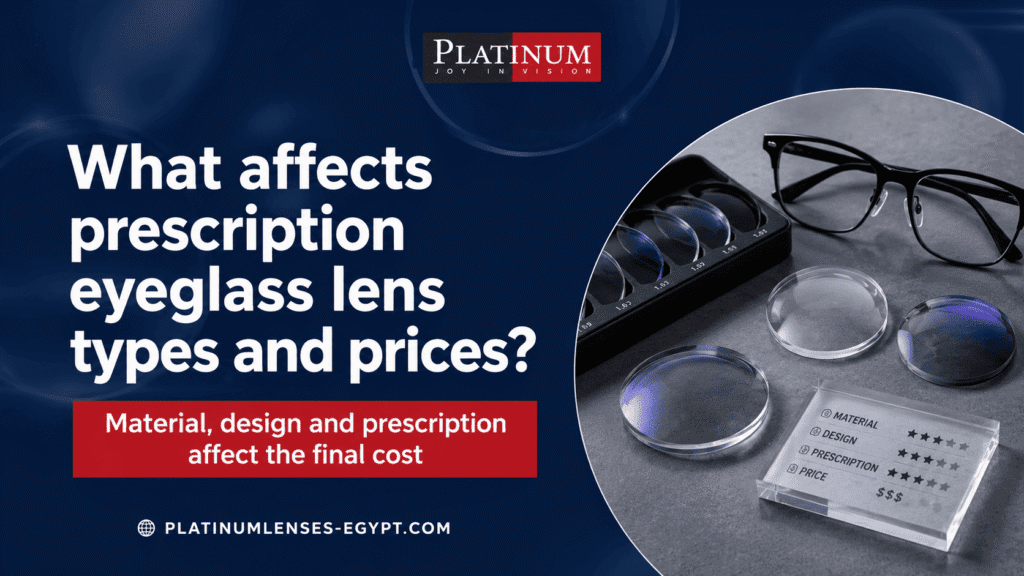
Prescription eyeglass lens types and prices are not decided by one factor only The final choice depends on your eye prescription, the lens material, the lens design, the coatings you need and the frame you choose This is why two people can buy glasses from the same optical store and still pay different prices
| Factor | Simple meaning | How it affects the lens |
|---|---|---|
| Lens material | The base material used to make the lens | Affects weight, thickness and impact resistance |
| Lens index | How strongly the material bends light | Higher index usually means a thinner and lighter lens |
| Lens design | How the power is distributed across the lens | Decides if the lens is for one distance or more than one distance |
| Coatings | Thin protective layers added to the lens | Improve clarity, reduce glare and protect from scratches or screen light |
| Eye prescription | Numbers like SPH, CYL, Axis, ADD and PD | Stronger prescriptions often need better materials and more accurate design |
This is why your eye prescription should be read carefully before choosing any lens material or coating A good lens choice is not only about price, because the wrong lens can feel heavy, thick or uncomfortable even if the frame looks nice
Learn More
How to Interpret a Prescription: A Simplified Guide for New Eyewear Buyers
Which lens material should you choose?
The material is one of the first things that affects prescription eyeglass lens types because it changes thickness, weight, durability and comfort Understanding prescription eyeglass lens types starts here because material can change how the glasses feel after a full day Some people only need a simple affordable lens, while others need a thinner material because their prescription is high or because they want a lighter frame for daily use
Standard plastic lenses
Standard plastic lenses are one of the common choices for mild and moderate prescriptions They are lighter than old glass lenses and give good visual clarity for normal daily use They are also easier to tint, which can make them useful for prescription sunglasses or colored lenses
This option usually suits people who want a practical and affordable lens The main point to remember is that standard plastic may look thicker with higher prescriptions, especially around the edges, so it is not always the best choice for strong minus or plus powers
Polycarbonate lenses
Polycarbonate lenses are known for being light and impact resistant This makes them a good choice for children, active people and anyone who needs stronger protection during daily movement They can also work well with rimless or semi rimless frames because the material is more resistant to breaking
The trade off is that polycarbonate lenses usually need good scratch resistant and anti reflective coatings to improve durability and visual comfort If someone is choosing glasses for a child or for active use, this material is worth discussing with the optician
Trivex lenses
Trivex lenses combine light weight, good clarity and strong impact resistance They are often chosen by people who want a comfortable lens that feels light on the face without giving up too much visual sharpness
This material can be useful for people who wear glasses for long hours or want a lens that works well with delicate frames It may cost more than basic options, but it can be a good choice when comfort and clarity matter more than choosing the cheapest lens
High Index lenses
High Index lenses are made for people who need thinner and lighter lenses, especially with stronger prescriptions The higher the index, the more the lens can reduce thickness while still correcting vision properly This makes the glasses look cleaner and feel more comfortable on the nose
High Index lenses are usually better for people with strong myopia, strong hyperopia or high astigmatism They also look better in many metal or premium frames These lenses usually work best with anti reflective coating because higher index materials can reflect more light
What are the main prescription eyeglass lens types by design?
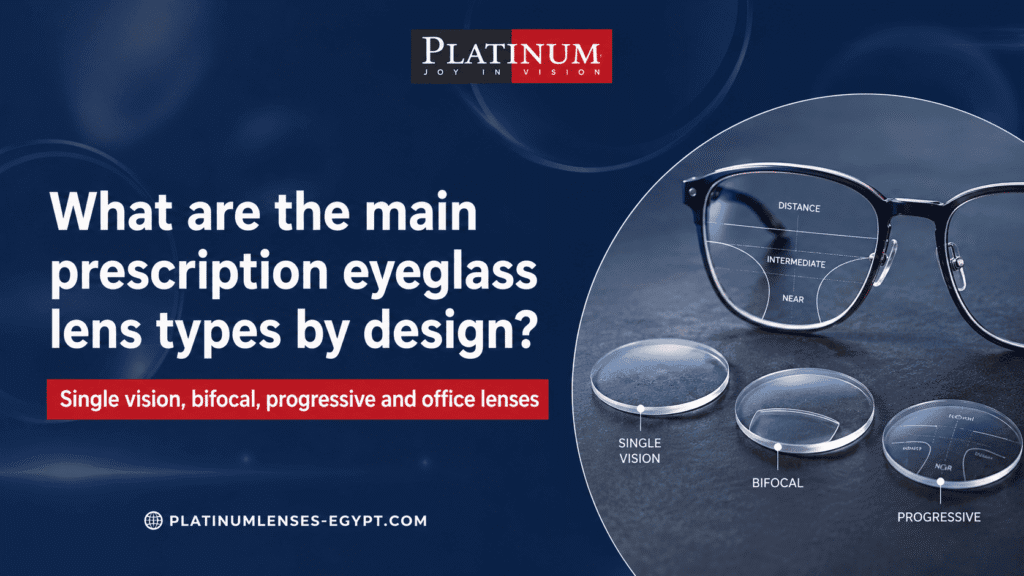
Prescription eyeglass lens types are also different by design, not only by material Some lenses correct one distance only, while others help you see far, near and intermediate distances through the same pair The right design depends on your age, daily routine and the numbers written in your prescription
Single vision lenses
Single vision lenses have one optical power across the whole lens They are used for correcting distance vision, near vision or astigmatism, depending on the prescription This is the most common type for students, drivers and people who need one pair of glasses for a clear single purpose
Platinum single vision options such as HD UT are made to give clear vision with a lighter and thinner design They can be a practical choice for many frames, especially if the user wants daily comfort without making the lens look thick
Bifocal lenses
Bifocal lenses are made for people who need two visual zones in one lens The upper part is usually for distance vision and the lower part is for reading or near work This design can help people who do not want to switch between two pairs of glasses
Bifocal lenses are still useful for some users, but many people now prefer progressive lenses because they do not have a visible separating line and feel more natural in daily use Platinum can still provide bifocal lenses when needed, and they can be combined with suitable protective coatings
Progressive lenses
Progressive lenses are designed for people who need clear vision at more than one distance They allow the eye to move from distance vision to intermediate vision and then to near vision without a visible line on the lens This makes them useful for people who read, drive, use screens and move between different tasks during the day
Platinum progressive lenses such as X Tend and X Perience T are designed to make this transition smoother X Perience T uses Digital Ray Path 2 technology to reduce edge distortion and improve comfort when looking around or moving This type needs accurate measurements because the eye position and frame fit both affect the final result
Office lenses
Office lenses are made for people who spend long hours on screens or work mostly at near and intermediate distances They are not the same as normal reading glasses because they give a wider working range for computer use, reading and desk tasks
This type can be helpful for employees, accountants, teachers and anyone who feels eye strain or neck discomfort while using a screen for long hours Platinum Office Lens can be paired with MIRA Blu to reduce discomfort from screen light and support better visual comfort during work
Myopia management lenses
Myopia management lenses are designed for children whose short sightedness keeps increasing over time The goal is not only to correct vision, but also to help manage the progression of myopia through a special optical design
Platinum Myo D is made for children who need myopia management and regular follow up The child still needs eye checks every few months because the prescription can change as the eye grows This type should always be chosen with professional advice from an eye care specialist
Which coatings matter with prescription eyeglass lens types?
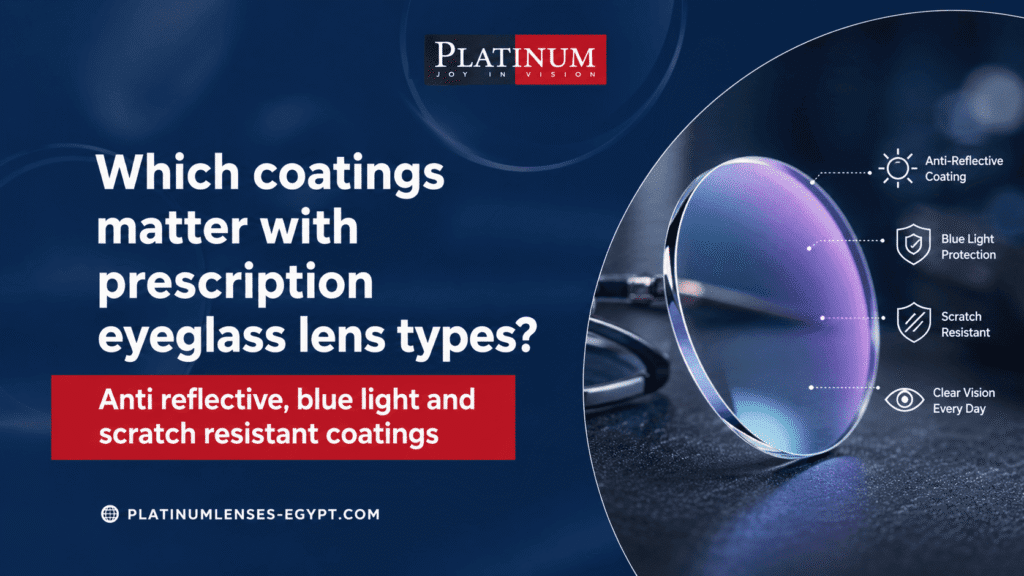
Coatings can change how prescription eyeglass lens types feel in real life This is why prescription eyeglass lens types should be compared with their coatings, not only by name A basic lens may correct vision, but the right coating can make it clearer, easier to clean and more comfortable under screens, lights or sunlight
| Coating | What it does | When it helps |
|---|---|---|
| Anti reflective coating | Reduces glare and improves lens transparency | Night driving, screens and study |
| Scratch resistant coating | Helps protect the lens surface from daily scratches | Children and daily use |
| Water and oil resistant coating | Makes the lens easier to clean | Dusty work areas and busy daily use |
| Blue light protection | Helps reduce discomfort from digital screens | Office work, gaming and long screen time |
| Photochromic coating | Darkens in sunlight and clears indoors | People who move between indoor and outdoor spaces |
| Night glare reduction | Reduces halos and strong light reflections | Long distance drivers and night use |
The right coating can affect the final price, but it can also make the glasses more useful every day A person who works on a laptop for eight hours does not need the same setup as someone who mostly drives at night or buys glasses for a child
How do Platinum lenses fit different needs?
Platinum Lenses offers different solutions for different prescription eyeglass lens types depending on the user’s prescription and daily routine When comparing prescription eyeglass lens types, the goal is to match comfort, clarity and daily use The better choice is usually the one that balances thickness, clarity, weight and comfort instead of focusing on price alone
| Your need | Suitable Platinum lens | Main benefit |
|---|---|---|
| Mild or moderate vision correction with a thinner look | HD UT | Digital design with lighter lens appearance |
| High astigmatism and wider visual comfort | X Perience T | Digital Ray Path 2 for better peripheral clarity |
| Long screen work | Office Lens with MIRA Blu | Comfortable intermediate vision and blue light support |
| Myopia management for children | Myo D | Designed to help manage myopia progression |
| One pair for far, intermediate and near vision | X Tend progressive lens | Smoother transition between distances |
Every lens should be matched with exact prescription details such as SPH, CYL, Axis, ADD and PD The frame shape and size also matter because a lens can be technically correct but still feel uncomfortable if the frame does not sit well on the face
How do you choose between prescription eyeglass lens types?
Choosing between prescription eyeglass lens types becomes easier when you start from your real daily needs A person who drives at night needs different support from someone who works all day on a computer, and a child who plays sports needs a different material from an adult who wants a thinner elegant lens
• Start with a complete eye exam and make sure your prescription includes the needed numbers
• Think about your day and whether you drive, study, work on screens or move outdoors often
• Choose the lens material based on prescription strength, comfort and frame shape
• Choose the design based on whether you need one distance, multiple distances or screen comfort
• Choose coatings based on your daily environment instead of adding every option without need
• Ask the optician to explain the difference between price options before making the final choice
There is no single perfect lens for everyone, and this is why prescription eyeglass lens types should be chosen according to real use The best lens is the one that fits your prescription, your frame and your lifestyle without making your glasses heavy, thick or uncomfortable
What affects the final price of prescription eyeglass lens types?
The final price of prescription eyeglass lens types usually changes according to material, design and coating Standard lenses for mild prescriptions are usually more affordable, while High Index lenses, progressive lenses and advanced coatings usually cost more because they need more precise production and better materials
Price should not be judged alone when comparing prescription eyeglass lens types A cheaper lens may be fine for a simple prescription, but it may not be the best choice for a high prescription, long screen use or progressive vision needs The better question is not which lens is cheapest, but which lens gives you comfortable vision for the way you actually use your glasses
FAQs
What is the difference between CR 39 and polycarbonate lenses?
CR 39 lenses are usually more affordable and give good clarity for mild or moderate prescriptions, while polycarbonate lenses are more impact resistant and better for children, active users and rimless frames Polycarbonate lenses usually need good coatings to improve scratch resistance and reduce glare
Are High Index lenses always better?
High Index lenses are better when you need a thinner and lighter lens, especially with strong prescriptions They are not always necessary for mild prescriptions, so the decision should depend on your prescription, frame choice and comfort needs
What is the difference between progressive and office lenses?
Progressive lenses help with distance, intermediate and near vision in one pair, so they are useful for daily movement between different tasks Office lenses are focused more on near and intermediate distances, making them more comfortable for screen work and desk use
Do lens coatings really matter?
Yes, coatings can make a big difference in daily comfort Anti reflective coating reduces glare, scratch resistant coating helps protect the lens and blue light protection can be useful for long screen use The best coating depends on your lifestyle
Can one lens type suit everyone?
No, prescription eyeglass lens types are not one size fits all The right lens depends on your prescription, age, frame, screen time, outdoor use and whether you need single vision, progressive, office or myopia management lenses
Learn More
Best Prescription Lenses for Vision Correction
Blue Cut Lenses: Do You Really Need Them?
Understanding Progressive Lenses: When to Recommend X-Tend or X-Perience
