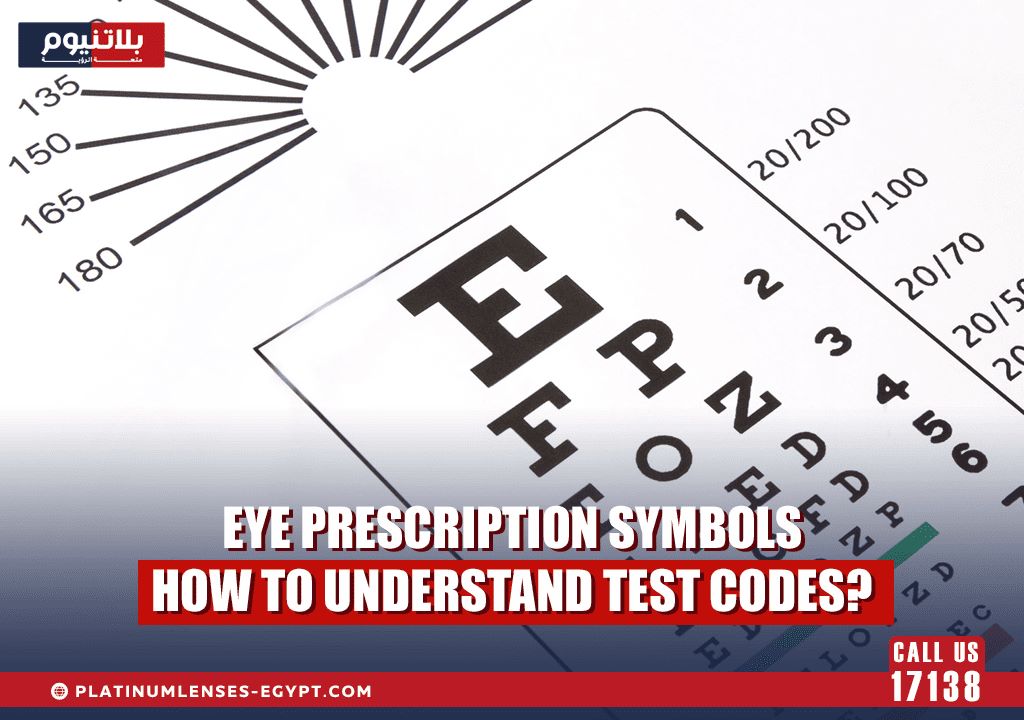
Eye prescription symbols can look confusing when you first receive your test paper, especially when you see short codes like SPH, CYL, Axis, PD, ADD and numbers such as 6/6 or 6/12 in the same chart The good news is that eye prescription symbols are not random codes They are a simple way to describe your vision, lens power and how your glasses should be made This guide explains eye prescription symbols in a clear way before choosing lenses
What do eye prescription symbols mean?
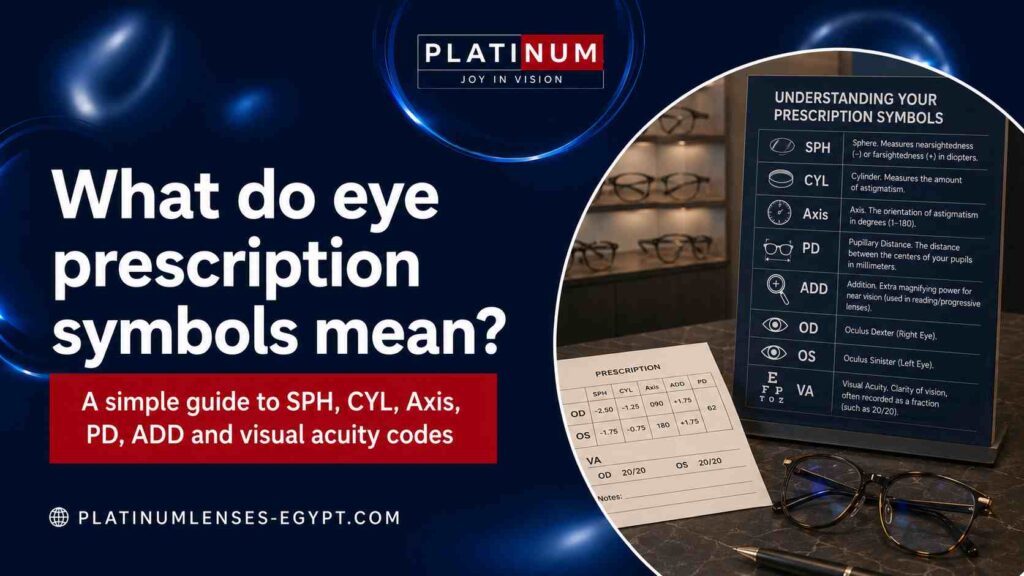
Eye prescription symbols are short medical codes used by eye doctors and opticians to describe your vision needs Each symbol explains one part of the prescription, such as whether you have nearsightedness, farsightedness, astigmatism, near vision difficulty or a lens centering requirement
The point is not to turn you into an optician, but to help you understand what is written on your chart When you know what the main eye prescription symbols mean, it becomes easier to ask the right questions and avoid choosing lenses without understanding why they are recommended
Why should you understand eye prescription symbols?
Understanding eye prescription symbols helps you follow changes in your vision over time If your prescription changes quickly, especially in children, teenagers or people with certain health conditions, it may be better to repeat the exam or ask the doctor why the numbers changed instead of only buying new glasses
It also helps when you buy glasses online or compare lens options A prescription can include the right lens power, but if Axis or PD is not handled accurately, the glasses may still feel uncomfortable Understanding eye prescription symbols gives you a clearer idea of what matters before the lens is made
What does 6/6 vision mean?
6/6 is a visual acuity result, not the same thing as your glasses power It means you can see from 6 meters what a person with normal vision is expected to see from the same distance This is often treated as normal visual clarity when the test is done correctly
6/6 and 20/20 vision
6/6 is used in meter systems, while 20/20 is common in the American system The meaning is very close because both describe normal distance vision, not the actual lens power written in SPH or CYL
6/12 vision
6/12 means you need to be at 6 meters to see what a person with normal vision can see from 12 meters This usually means distance vision is weaker than normal and may need correction depending on the full eye exam
6/60 vision
6/60 means vision is much weaker because you see from 6 meters what a person with normal vision can see from 60 meters This result needs proper professional evaluation, especially if it appears suddenly or affects daily activities like walking, driving or reading signs
What does SPH mean in eye prescription symbols?
SPH means Sphere and it shows the main lens power needed to correct nearsightedness or farsightedness It is usually one of the first eye prescription symbols people notice because it often appears with a plus or minus sign
Learn More
What Does SPH Mean in an Eye Test?
Negative SPH
Negative SPH usually means nearsightedness, where close objects are clearer than far objects For example, a person with a negative SPH value may find road signs, classroom boards or far details blurry without glasses
Positive SPH
Positive SPH usually means farsightedness, where near tasks may feel harder than distance vision Reading, phone use or close work can cause eye strain when the positive value needs correction
Stronger SPH numbers
The higher the number, the stronger the lens power needed This can affect lens thickness and frame choice, especially if the prescription is high or the frame is large
What does CYL mean in eye prescription symbols?
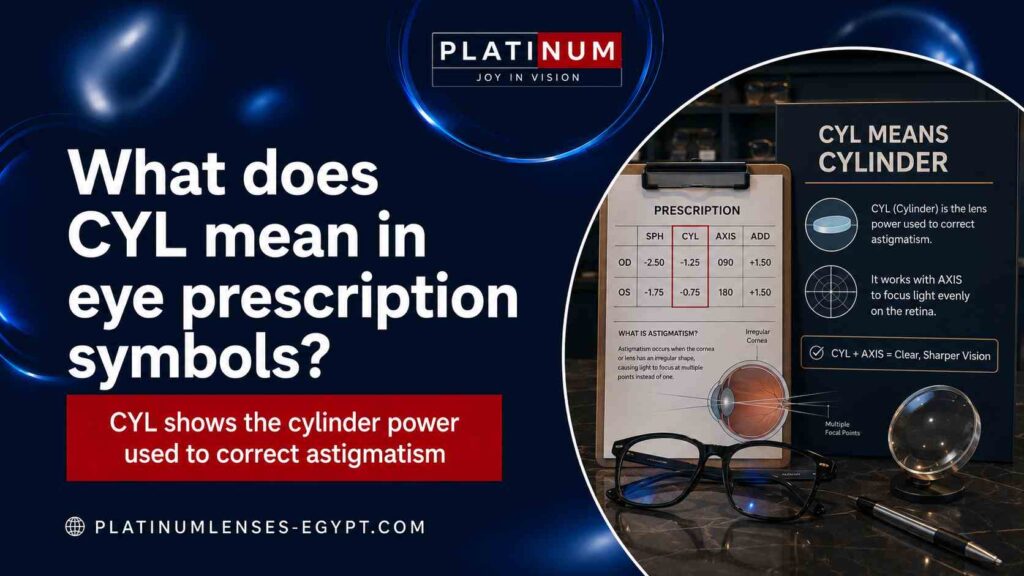
CYL means Cylinder and it is used to correct astigmatism Astigmatism happens when the eye does not focus light evenly, often because the cornea or lens has an uneven curve
If the CYL box has a number, it means the lens needs cylindrical correction If the box is empty or says zero, there may be no clear astigmatism correction needed CYL is one of the eye prescription symbols that should usually be read with Axis, because both values affect lens comfort
CYL and blurred vision
A higher CYL value can make vision look stretched, shadowed or unclear This is often more noticeable while reading small text, using screens, driving at night or looking at bright lights
CYL with Axis
CYL should usually be read with Axis because CYL tells how much astigmatism correction is needed, while Axis tells where that correction should be placed inside the lens
What does Axis mean in eye prescription symbols?
Axis is the direction of astigmatism correction It is written as a number from 0 to 180 degrees and it tells the optical lab how to position the cylindrical power inside the lens
Axis is not a strength number by itself It does not mean your vision is worse or better, but it becomes very important when CYL is present because the lens must correct astigmatism in the correct direction This makes Axis one of the eye prescription symbols that can strongly affect how natural the glasses feel
Why Axis accuracy matters
If Axis is not accurate, the glasses may feel uncomfortable even when the SPH and CYL numbers look right You may feel blur, eye strain or a strange sense that the image is not stable
What does PD mean in glasses?
PD means Pupillary Distance and it measures the distance between the centers of your pupils This number helps the optical lab place the lens center in front of your eyes
PD may look like a small measurement, but it can affect comfort a lot If the lens center does not line up with your pupils, your eyes may work harder to see clearly and you may feel headaches or visual discomfort This is why PD should not be ignored when reading eye prescription symbols
PD in online glasses orders
PD becomes even more important when ordering glasses online because the lab depends on the number you provide A wrong PD can make the glasses feel strange even when the rest of the prescription is correct
What does ADD mean in eye prescription symbols?
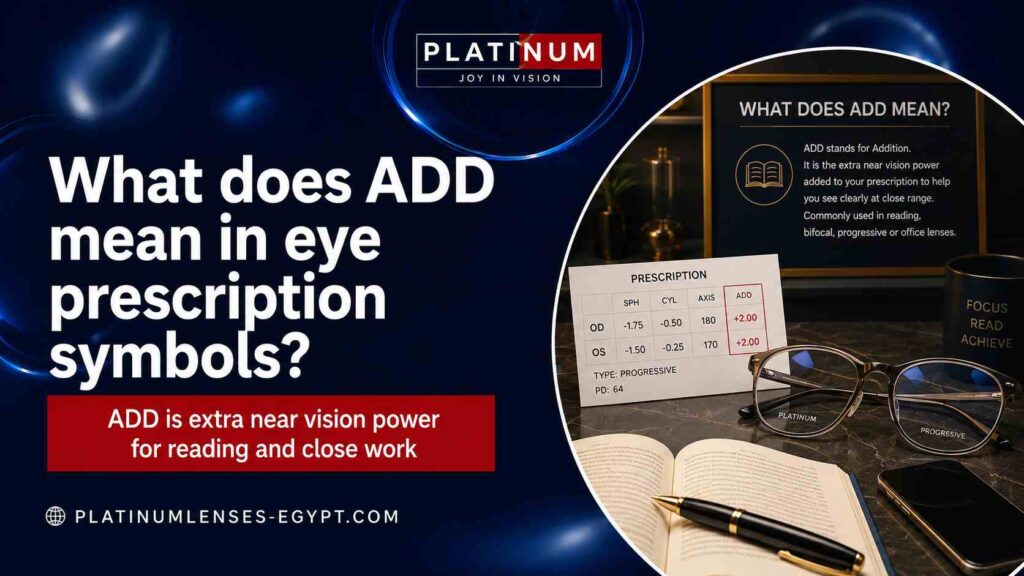
ADD means Addition and it is extra near vision power It usually appears in prescriptions for people who need help with reading, phone use or close work, often after the age of forty
ADD is commonly used in progressive, bifocal or office lenses If you start holding your phone farther away or feel tired while reading small text, ADD may be part of the solution, but it should be confirmed through a proper eye exam
What do OD and OS mean?
OD and OS help separate the right eye from the left eye OD means the right eye and OS means the left eye You may also see OU, which means both eyes together
| Symbol | Meaning | Why it matters |
|---|---|---|
| OD | Right eye | Shows the prescription for the right eye |
| OS | Left eye | Shows the prescription for the left eye |
| OU | Both eyes | Used when a value applies to both eyes |
This matters because both eyes often have different values One eye may have more SPH, another may have more CYL, and sometimes the Axis direction can be different between the two eyes
What is the difference between spherical and cylindrical lenses?
A spherical lens corrects nearsightedness or farsightedness through SPH It has a more even optical correction across the lens and is used when the main issue is distance or near focusing
A cylindrical lens corrects astigmatism through CYL and Axis It has correction in a specific direction because astigmatism is not the same in every angle of the eye Many people need both spherical and cylindrical correction in the same lens, so reading eye prescription symbols as a full group is more useful than reading one code alone
How do you read eye prescription symbols step by step?
The easiest way to read eye prescription symbols is to move through the chart in order Start with OD and OS so you know which eye you are reading, then check SPH to understand the main lens power After that, look at CYL and Axis to see whether astigmatism correction is included, then check ADD if there is near vision support and PD for lens centering
| Field | What to check | What it tells you |
|---|---|---|
| SPH | Plus or minus value | Nearsightedness or farsightedness |
| CYL | Cylinder value | Astigmatism correction |
| Axis | Number from 0 to 180 | Direction of astigmatism correction |
| ADD | Positive near value | Reading or close vision support |
| PD | Millimeter distance | Lens centering inside the frame |
| 6/6 or 6/12 | Visual acuity result | How clearly you see at distance |
If the symbols still feel mixed together, read the full prescription in order instead of looking at one number on its own This helps you understand how the values work together before choosing your lenses
When do prescription numbers mean weak eyesight?
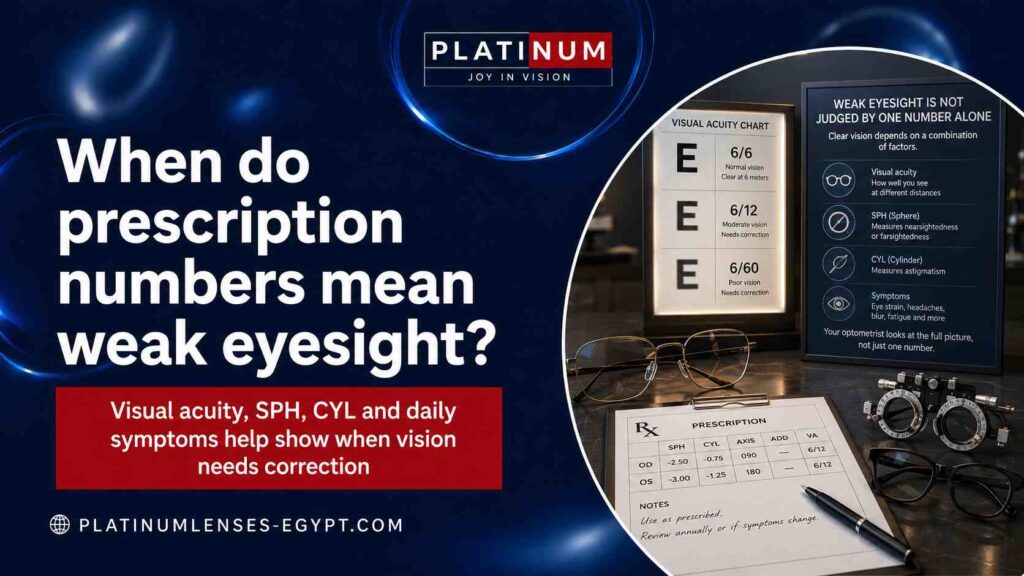
Weak eyesight is not judged from one number only Visual acuity, SPH, CYL and daily symptoms all matter A person with 6/12 vision may need correction for distance, while another person may have normal visual acuity but still need glasses for astigmatism or near work
In general, repeated headaches, blurry distance vision, eye strain while reading, trouble driving at night or frequent squinting are signs that you should not ignore the prescription A full exam is still the safest way to know whether glasses are needed
How do eye prescription symbols affect lens choice?
Eye prescription symbols affect the lens design, thickness, coating and frame suitability A high SPH value may need a thinner lens, CYL and Axis need accurate astigmatism correction, ADD may require progressive or office lenses, and PD helps the lens sit correctly in front of the eyes
The right lens is not chosen from one code only A good optician reads the full chart, checks how you use your eyes during the day, then recommends a lens that fits your prescription, frame and lifestyle
How can Platinum Lenses help?
Platinum Lenses can help you understand your eye prescription symbols and match them with the right lens option This is useful if you have astigmatism, high SPH values, near vision needs after forty, long screen use or difficulty choosing between different lens coatings
Instead of guessing from the numbers alone, you can use the prescription as a starting point and ask which lens design gives you better comfort for your daily routine The goal is not just clear vision for a few minutes in the store, but comfortable vision throughout the day
FAQs
What are the most common eye prescription symbols?
The most common eye prescription symbols are SPH, CYL, Axis, PD, ADD, OD, OS and visual acuity numbers like 6/6 Each one explains a different part of your vision or lens design
What does SPH mean in a prescription?
SPH means Sphere and it shows the main lens power needed to correct nearsightedness or farsightedness A negative value usually means nearsightedness and a positive value usually means farsightedness
Is CYL the same as astigmatism?
CYL is the prescription value used to correct astigmatism If there is a number in the CYL field, the lens usually needs cylindrical correction
Why is Axis important?
Axis tells the optical lab where to place the astigmatism correction inside the lens If Axis is wrong, the glasses may feel uncomfortable even if the CYL power is correct
Does 6/6 mean I do not need glasses?
Not always 6/6 means normal distance visual acuity, but you may still need correction for astigmatism, near work, eye strain or other lens needs depending on the full prescription
Learn More
Understanding CYL in Eye Exams: A Beginner’s Guide
Axis in Eye Prescription: What It Really Means
How to Interpret a Prescription: A Simplified Guide for New Eyewear Buyers
